
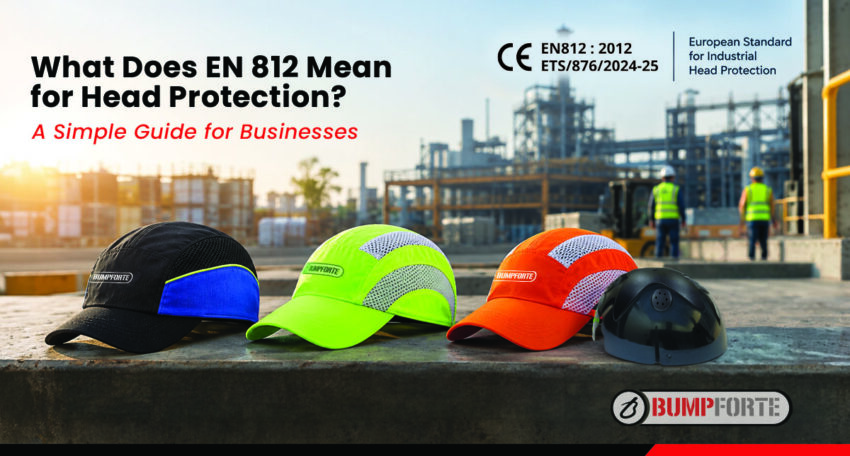
What Does EN 812 Mean for Head Protection? A Simple Guide for Businesses
Head protection is not always about wearing a safety helmet.
In some workplaces, the bigger concern may be something much more common: a worker hitting their head against a low beam, pipe, machine component or another fixed object.
This is where industrial bump caps come into the picture.
But how do you know when a bump cap is appropriate? What does EN 812:2012 actually mean? And how is it different from the standard used for industrial safety helmets?
Let’s break it down.
What Is EN 812:2012?
EN 812:2012 is a European standard that applies to industrial bump caps.
It defines requirements around the construction, performance, testing and marking of these products.
The important thing to understand is what they are designed for.
A bump cap is intended to help protect the wearer when their head strikes a hard, stationary object.
Think of situations such as:
- Walking into a fixed beam
- Standing up underneath a low structure
- Working around exposed machinery components
- Moving through restricted spaces
- Coming into contact with pipes or other fixed structures
It is designed for these everyday workplace risks rather than every possible head injury.
Why Does This Difference Matter?
This is where businesses often need to be careful.
Not every form of head protection is designed for the same hazard.
A worker may need protection because they could hit their head against a fixed object. Another worker may be exposed to falling materials or objects from above.
Those are two different risks.
Choosing protective equipment should therefore begin with a simple question:
What could actually happen in this workplace?
The answer should guide the type of protection provided.
What Is a Bump Cap Designed to Protect Against?
An industrial bump cap is designed around the risk of contact with hard, stationary objects.
For example, imagine a technician working underneath equipment. The biggest risk in that particular area may be repeatedly coming into contact with low or protruding structures.
A bump cap can be relevant in such situations, subject to the workplace risk assessment.
However, it is important to understand what it is not designed for.
A bump cap should not be treated as protection against:
- Falling objects
- Thrown objects
- Suspended loads
- Moving loads
- Hazards requiring industrial safety helmet protection
That distinction is critical.
A bump cap is not a lighter version of a safety helmet.
It is a different type of protective equipment for a different risk.
How Is a Bump Cap Different From a Safety Helmet?
The easiest way to understand the difference is to look at the standards and the hazards they address.
| Industrial Bump Cap | Industrial Safety Helmet | |
|---|---|---|
| Standard | EN 812 | EN 397 |
| Designed for | Contact with hard, stationary objects | Specified industrial head hazards |
| Falling-object protection | No | Designed for relevant hazards |
| Use | Depends on workplace risk assessment | Depends on workplace risk assessment |
So there isn’t really a question of which one is “better.”
The better question is:
Which one is appropriate for the hazard?
What Does EN 812 Test?
EN 812 includes requirements for the physical characteristics and performance of industrial bump caps.
This includes areas such as impact performance and penetration resistance.
Why does that matter?
Because workplace head injuries aren’t limited to large impacts.
A worker could hit their head against a sharp edge or protruding part of a fixed structure. The design therefore needs to address more than just the outer appearance of the product.
The standard also includes requirements around product marking and information, helping users identify the relevant product and its characteristics.
Why Does Penetration Resistance Matter?
Imagine a worker moving through a cramped maintenance area.
There may be exposed corners, brackets, pipes or other components around them.
A simple collision with one of these objects could cause a cut or other superficial injury.
This is why penetration resistance is an important part of the performance requirements.
It highlights a broader point:
Protective equipment needs to be designed around the way a workplace is actually used.
Where Can Bump Caps Be Useful?
There is no single industry where a bump cap automatically becomes the right choice.
Its suitability depends on the hazards identified in the workplace.
They may be considered in environments such as:
Manufacturing
Employees may work around machinery, production lines and fixed structures.
Warehousing
Workers can move around racking, shelving and other structures where head-level obstacles may be present.
Maintenance
Technicians often work in confined or awkward spaces where fixed objects can create everyday head-strike risks.
Utilities and Infrastructure
Some tasks involve working around pipes, equipment and other permanent structures.
Service and Technical Work
Field and technical personnel may encounter restricted spaces or fixed components during routine work.
The important point is that the environment alone does not determine the right PPE. The actual hazard does.
When Is a Bump Cap Not Enough?
This is perhaps the most important consideration.
If there is a possibility of an object falling from above, a bump cap should not be treated as an alternative to the appropriate industrial safety helmet.
The same applies to workplaces involving significant impact hazards or suspended and moving loads.
For example, a worker underneath lifting operations faces a very different risk from someone working in a low-clearance maintenance area.
Both workers may need head protection.
But they may not need the same type of head protection.
What Should Businesses Check Before Choosing One?
Selecting the right product involves more than checking the standard printed on the packaging.
Businesses should consider:
What Is the Actual Hazard?
Start with the workplace risk assessment.
Identify what could cause injury and how likely workers are to encounter it.
Is the Product Suitable for That Risk?
A product should be selected according to its intended use rather than simply because it is classified as head protection.
Will Employees Wear It Comfortably?
Protection that is uncomfortable or poorly fitted can become difficult to use consistently.
Consider:
- Fit
- Weight
- Adjustment
- Ventilation
- Duration of wear
- Working conditions
Does It Work With Other PPE?
Workers may also need safety glasses, hearing protection, high-visibility clothing or other equipment.
The different pieces should work together without creating unnecessary discomfort or interference.
What Documentation Comes With the Product?
Procurement teams should look at product markings, technical information and relevant conformity documentation rather than relying only on product claims.
Why Does Comfort Matter So Much?
There is a practical side to PPE that technical specifications don’t always capture.
Employees may wear protective equipment for several hours every day.
If something is heavy, uncomfortable, poorly ventilated or difficult to adjust, it can affect how consistently it is worn.
That makes comfort part of the overall selection process.
For everyday workplace protection, businesses should look at the combination of:
Protection. Fit. Comfort. Practicality.
Not just one of them.
Is CE Marking the Same as EN 812?
No.
These two terms refer to different things.
EN 812 is a technical standard relating to industrial bump caps.
CE marking relates to conformity with applicable European requirements.
So seeing a CE mark does not, by itself, tell you that a product meets EN 812.
Businesses should review the relevant product documentation and conformity information to understand exactly what the product complies with.
What Is the Difference Between EN 812 and EN 397?
In simple terms:
EN 812 → Industrial bump caps
EN 397 → Industrial safety helmets
The distinction matters because the products are designed around different workplace risks.
A bump cap should therefore not be selected simply because it looks more comfortable or convenient than a helmet.
Likewise, a helmet should not automatically be used for every situation without considering whether it is the most practical option for the identified hazard.
Start with the risk. Then select the protection.
How Is Brij Making Everyday Head Protection More Practical?
This is where product design becomes important.
Brij’s Bump Forte is designed for workplaces where protection against everyday bumps and scrapes is relevant. It combines an EN 812:2012-compliant bump-cap design with features such as a lightweight construction, ventilation and breathability for regular use.
But workplace PPE doesn’t always have to look generic.
Bump Forte can also be customised for businesses, allowing organisations to bring their identity into everyday workplace apparel while maintaining the intended function of the product.
For businesses looking for a practical option for lower-risk head-strike environments, the focus is simple:
Protection that fits the workplace.
Comfort that supports everyday use.
A design that can represent the organisation wearing it.
What Are Some Common Misconceptions?
Is a Bump Cap a Safety Helmet?
No.
They are two different types of head protection designed for different applications.
Can a Bump Cap Be Used Where Objects May Fall?
No.
A bump cap should not be considered a replacement for appropriate safety helmet protection where falling-object hazards exist.
Does EN 812 Mean the Product Can Be Used Anywhere?
No.
The workplace still needs to be assessed to determine whether the product is appropriate.
Does Meeting a Standard Guarantee Complete Protection?
No PPE can eliminate every workplace risk.
The equipment needs to be used correctly and as part of a broader workplace safety approach.